
The FedRAMP audit process, in depth
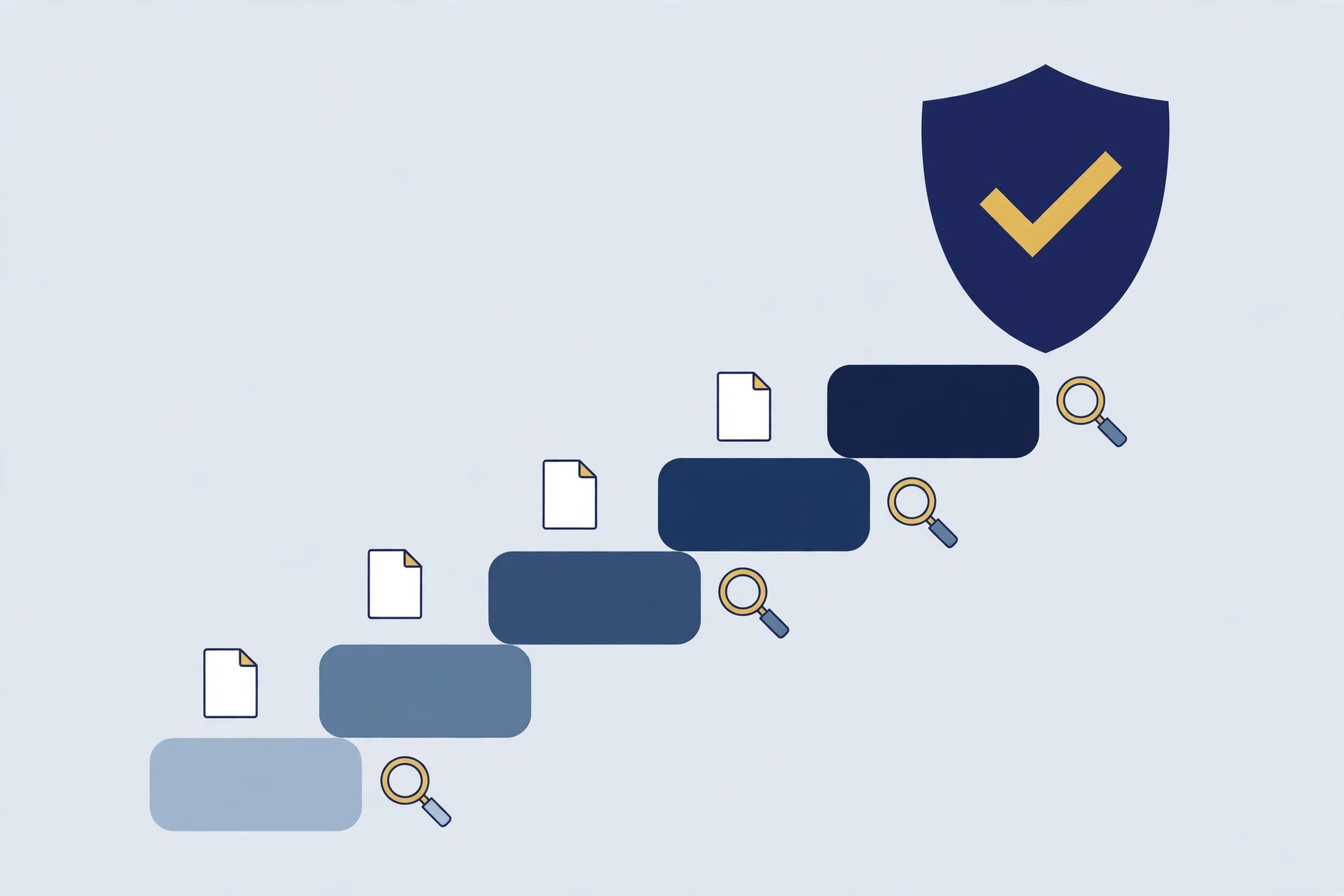
Six phases take a cloud service from first strategy conversation to a listed, continuously monitored authorization. The 3PAO shows up at three points: readiness, the full assessment, and the annual reassessment. It never makes the authorization decision.
Last updated: 2026-11-22.
Any cloud service used by a federal agency generally must be FedRAMP authorized. OMB Memorandum M-24-15 directs agencies to use FedRAMP for risk assessments, security authorizations, and ATOs for cloud services. The phases below describe the traditional Rev5 / agency path, which is still the path most services are on today. The differences under FedRAMP 20x are covered at the end of the page.
Who does what
Four parties carry the audit, and confusing their roles is the most common misunderstanding in the whole process.
| Party | Role in the audit | What it does not do |
|---|---|---|
| The CSP (cloud service provider) | Builds the system, implements the controls, writes the SSP, fixes findings, and reports monthly once authorized. | Does not assess its own system or grant its own authorization. |
| The 3PAO (independent assessor) | Plans the assessment, tests controls, interviews staff, scans, pen-tests, and writes the SAR and POA&M. | Does not grant authorization, and cannot implement controls, remediate findings, or write the SSP for a system it assesses. |
| The AO (Authorizing Official) | The sponsoring agency's official who reviews the package and decides whether to grant the Authority to Operate. | Does not test controls or write assessment reports. |
| The FedRAMP PMO | Reviews the package, lists the service as FedRAMP Certified in the Marketplace, and oversees continuous monitoring. Under 20x Low, it issues program certification directly. | Does not perform the assessment. |
Phase 0: Sponsor and strategy (3–12 months, in parallel)
On the agency path, everything starts with a sponsor: a federal agency whose Authorizing Official will review the authorization package and grant the ATO. Without one, the agency path cannot proceed, and finding one is the phase most first-time CSPs underestimate. The optional FedRAMP Ready designation in Phase 1 exists largely to help attract a sponsor.
In parallel, the CSP defines the impact level or certification class, the authorization boundary, and the budget. The boundary is typically a dedicated federal environment running on FedRAMP-authorized infrastructure, such as AWS GovCloud or Azure Government. A narrow, well-defined boundary costs less to assess than a sprawling one, which is one reason boundary decisions made here echo through the rest of the process.
Phase 1: Readiness
Readiness means measuring the service against the applicable baseline and closing the gaps before anyone formal tests anything. The usual remediation items are FIPS 140-validated cryptography, centralized logging, multi-factor authentication, configuration baselines, and vulnerability management. How much work this takes depends entirely on how the service was built; a system designed with the baseline in mind moves through readiness quickly, and one retrofitted to it does not.
Optionally, a 3PAO performs a Readiness Assessment Report (RAR), which earns the FedRAMP Ready designation (now shown as "Legacy FedRAMP Ready" in the Marketplace). FedRAMP Ready is available for Moderate and High only, requires no agency partner, and is valid for one calendar year. It is a signal to prospective sponsors, not an authorization. The readiness assessment page covers the RAR in full, including what it costs and what it does not do.
Phase 2: Documentation (3–6 months)
The centerpiece is the System Security Plan (SSP): the CSP's description of the system, its boundary, and how each control in the applicable baseline is implemented. Around it sit the attachments: policies and procedures for each control family, the incident response plan, the contingency plan, the configuration management plan, and the system inventory. FedRAMP provides templates for all of it.
Two things to know about the SSP. First, the independence rule applies here: the 3PAO that will assess the system cannot write its SSP. The CSP writes it in-house, hires an advisor, or generates much of it from a GRC platform. Second, documentation is going machine-readable. RFC-0024 mandates machine-readable (OSCAL) packages for all FedRAMP providers, with requirements effective September 30, 2026. New packages should be built in OSCAL from the start rather than converted later.
How big is the baseline? The Rev5 baselines run to roughly 125 controls at Low, 325 at Moderate, and 421 at High. Those are commonly cited approximations; counts vary by counting method. LI-SaaS, the tailored low-impact SaaS baseline, runs to about 37 controls, up to roughly 50–60 if PII or mobile applies. Moderate is the most common baseline, at around 80% of authorizations.
Phase 3: The full assessment (2–4 months including remediation and retesting)
This is the audit proper. The 3PAO starts by writing the Security Assessment Plan (SAP), which sets out what will be tested, how, and in what order. Then the testing begins. The testing window is typically 6–12 weeks, and SAP to SAR often runs 8–16 weeks.
What the assessors do in that window:
- Test controls against the applicable baseline, following NIST SP 800-53A Rev 5 assessment procedures, and examine the evidence the CSP produced in Phase 2.
- Interview staff who operate the system, to confirm that documented procedures match what people do.
- Run vulnerability scans across the operating systems, databases, and web applications in the boundary.
- Conduct penetration testing, required for Moderate and High (not for Low or LI-SaaS). The initial test must be no more than 6 months before SAR submission, and pen testing repeats at least every 12 months thereafter. Pen Test Guidance v3 (June 30, 2022) remains the binding version; v4.0 has been in draft since March 2024.
The output is the Security Assessment Report (SAR), which records what the testing found, including a Risk Exposure Table for the findings, and the Plan of Action and Milestones (POA&M), which tracks every open finding with a unique ID, the affected control, severity, asset, owner, milestones, scheduled completion date, status, and closure evidence. High-risk findings generally must be remediated and retested before authorization. FedRAMP will not grant certification with open High findings. The remediation page covers the clocks and the retest cycle in detail.
Phase 4: The authorization decision (typically 2–6 months)
The sponsoring agency's AO reviews the package: SSP, SAR, and POA&M. If the AO is satisfied with the residual risk, the AO issues the ATO letter. The FedRAMP PMO then reviews the package and lists the service as FedRAMP Certified in the Marketplace. Other agencies can then reuse the package to issue their own ATOs, which is the "do once, use many times" idea the program is built on. Timelines vary with the agency and the package; some sources put agency ATO review at up to 12 months.
Phase 5: Continuous monitoring (indefinitely)
Authorization is maintained, not finished. Once authorized, the CSP reports monthly, undergoes an annual 3PAO reassessment, and pen-tests at least every 12 months. The continuous monitoring page covers the monthly deliverables, the reassessment cycle, and what happens if a CSP lapses.
Timelines by level and class
| Level / class | Assessment phase | End to end |
|---|---|---|
| Low (Class B) | 2–4 months including remediation and retesting; testing window typically 6–12 weeks; SAP to SAR often 8–16 weeks. | ~12–18 months |
| Moderate (Class C) | 12–24 months | |
| High (Class D) | 18–36 months |
The assessment phase itself is the shortest part of the journey. Most of the calendar goes to sponsorship, readiness, and documentation, which is why CSPs that start those early finish earlier.
Authorization paths
| Path | Who authorizes | Status |
|---|---|---|
| Agency authorization | A sponsoring agency's Authorizing Official grants the ATO; the PMO reviews and lists the service as FedRAMP Certified. | The standard path today. |
| JAB authorization (P-ATO) | The Joint Authorization Board (DoD, DHS, GSA) issued a Provisional ATO, which agencies could then leverage. | Retired. Governance moved to the FedRAMP Board, which is a governance body, not a sponsor. Existing JAB-authorized services transitioned without losing status. |
| FedRAMP 20x | For 20x Low, no agency sponsor is required: the PMO issues program certification directly. 20x Moderate retained sponsorship during the pilot. | Active. Class A opened August 3, 2026; Classes B and C opened August 31, 2026. Class D is not yet operational; the 20x Class D pilot is estimated for FY27 Q1–Q2. |
How 20x changes the process
- Evidence, not narrative. Narrative control documentation is replaced by Key Security Indicators (KSIs), measurable and automatable security outcomes validated against machine-readable evidence in OSCAL packages. KSI counts vary between sources and change as the rules dataset is updated, so this site publishes no settled number.
- No sponsor needed at the low end. For 20x Low, the PMO certifies directly, removing the sponsorship bottleneck that stalls many first-time CSPs on the agency path.
- Assessment is mandatory from Class B up. Class A does not require independent assessment; Classes B and C do. The assessor's role shifts toward validating KSIs and machine-readable evidence.
- Faster remediation clocks. Under 20x, a likelihood × impact matrix replaces the flat 30/90/180-day model, with fixes as fast as 2 days for likely-exploited high-impact flaws and evaluation within 2 days (High), 5 days (Moderate), or 7 days (Low) of detection.
- OSCAL is mandatory. RFC-0024 requires machine-readable (OSCAL) packages for all FedRAMP providers, effective September 30, 2026.
Frequently asked questions
What is the difference between the SAP, SAR, and SSP?
The SSP (System Security Plan) is the CSP's description of its system and how each control is implemented. The SAP (Security Assessment Plan) is the 3PAO's plan for testing those controls. The SAR (Security Assessment Report) is the 3PAO's record of what the testing found.
What happens if the assessment finds problems?
Findings go on the POA&M with remediation clocks: Critical and High findings in 30 days, Moderate in 90, Low in 180. High and Critical findings must be remediated and retested before authorization is granted. See the remediation page.
Does authorization expire?
Authorization has no fixed expiry date, but it is maintained only through continuous monitoring: monthly reporting, annual 3PAO reassessment, and annual penetration testing. Missing deadlines without an approved deviation can lead to suspension or revocation.
Do I need an agency sponsor for FedRAMP?
On the traditional agency path, yes. Under FedRAMP 20x Low, no agency sponsor is required: the PMO issues program certification directly. 20x Moderate retained sponsorship during the pilot.
The next question is usually money. The cost guide breaks out every fee line, and the remediation page covers what happens when the assessment finds problems.